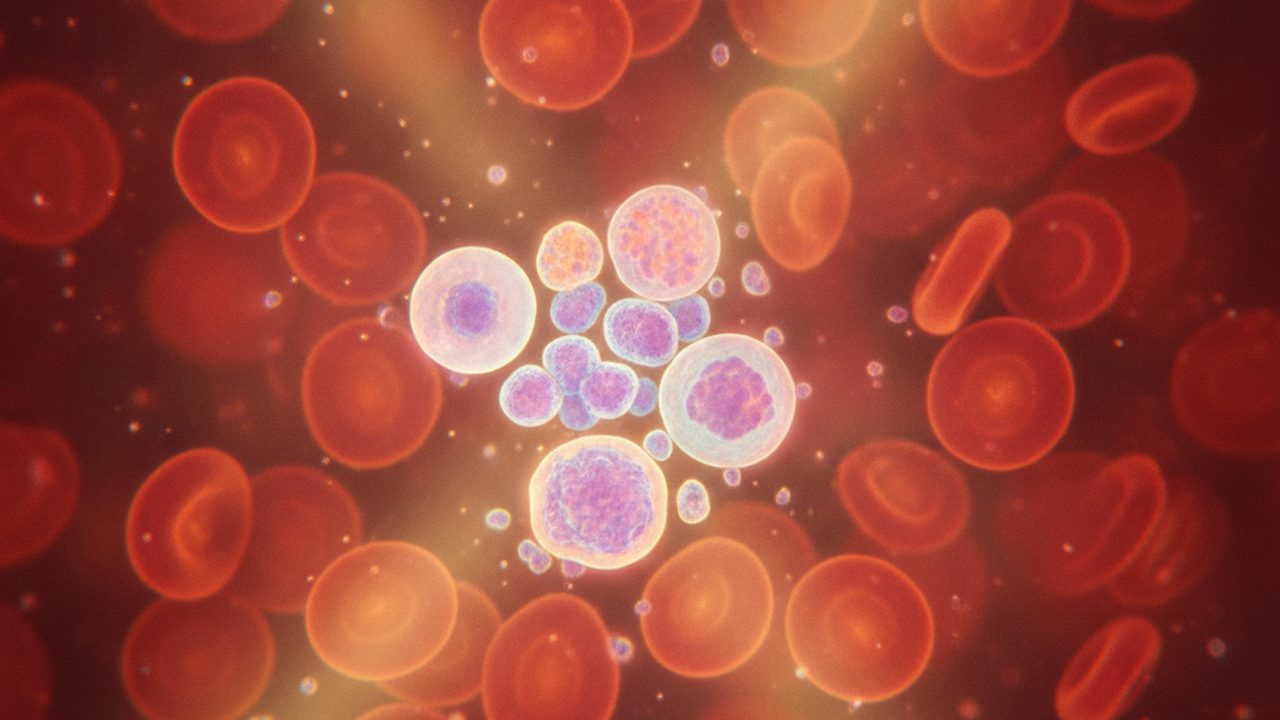
Two biomarkers that were never supposed to meet
Steve Horvath's multi-tissue epigenetic clock, published in 2013, was built from 8,000 samples across 82 datasets and 51 tissue types, and reduced biological age to a weighted read of methylation at 353 CpG sites.[4] It launched an industry. A decade later you can post a blood sample to a laboratory and receive a number telling you that you are, biologically, 47 rather than 42.
Clonal haematopoiesis came from a different direction entirely — cancer genetics. In 2014, Siddhartha Jaiswal and colleagues sequenced the exomes of 17,182 people who had no known blood disorder and looked for the mutations that recur in blood cancers. They found them, in large numbers, in ordinary people. Detectable clones were rare before 40, then rose steeply: 9.5% at ages 70–79, 11.7% at 80–89, and 18.4% among those aged 90–108. The great majority of mutations sat in three genes — DNMT3A, TET2 and ASXL1.[2]
These were separate literatures with separate conferences. The July 2026 meta-analysis is the first systematic attempt to ask whether they are measuring overlapping biology.
What the meta-analysis found
Matthew Simonson and colleagues, working across the University of Illinois at Chicago, the National University of Singapore and the University of Sydney, searched six databases for studies published between January 2011 and June 2025, following PRISMA 2020 methodology. Five studies met criteria, covering 7,483 individuals aged 55–79, 67.1% female. Three of those, totalling 6,946 people, were poolable in a random-effects meta-analysis.[1]
Across all four DNA methylation clocks tested, CHIP carriers were epigenetically older than non-carriers.
| Epigenetic clock | Extra age in CHIP carriers | 95% confidence interval |
|---|---|---|
| Horvath1Age (IEAA) | 2.84 years | 1.49 – 4.19 |
| HannumAge (EEAA) | 2.31 years | 1.14 – 3.49 |
| PhenoAge | 1.84 years | 0.96 – 2.71 |
| GrimAge | 1.20 years | 0.80 – 1.61 |
Two features of that table are more informative than the point estimates. First, every confidence interval excludes zero, across four clocks built on different training data and different outcome targets — that consistency is harder to explain away than any single result. Second, the effect was dose-dependent: larger clones were associated with greater acceleration. Dose-response is one of the classical criteria for taking an association seriously.
The TET2 detail that makes mechanistic sense
Both DNMT3A- and TET2-mutated CHIP were associated with higher epigenetic age acceleration, but TET2 showed larger effect sizes and more consistent associations across clocks.[1]
This is the sort of detail that separates a real signal from a statistical artefact. TET2 encodes an enzyme that removes methyl groups from DNA — it is a direct participant in the machinery epigenetic clocks read. DNMT3A, conversely, adds them. A mutation that disables a demethylase should be expected to shift the methylation landscape a clock is trained on. Finding the larger effect in exactly the gene where mechanism predicts it is reassuring in a way that a bare correlation would not be.
Why this complicates the consumer biological age test
Here is the practical consequence, and it has not been widely discussed.
Most consumer epigenetic age tests are run on blood, because blood is what you can post in an envelope. They are marketed with the implicit promise that the number responds to behaviour: sleep better, exercise more, retest, watch it fall. For much of the population that framing is defensible.
But if you are 75, there is roughly a one-in-ten chance you carry a detectable blood-cell clone,[2] and if you do, the meta-analysis suggests a meaningful part of your "accelerated" reading may be tracking that clone rather than your habits. No amount of sleep optimisation shrinks a TET2-mutated clone. You would be chasing a number that is partly reporting on a somatic mutation process in your bone marrow.
And that clone is not a trivial finding. In the 2014 cohort, CHIP carried a hazard ratio of 11.1 for haematologic cancer (95% CI 3.9–32.6), 1.4 for all-cause mortality, 2.0 for incident coronary heart disease and 2.6 for ischaemic stroke.[2] A follow-up study in 2017 across 4,726 coronary cases and 3,529 controls found CHIP carriers had roughly 1.9 times the risk of coronary heart disease, rising to 4.0 times for early-onset myocardial infarction — and demonstrated causality in mice, where Tet2-knockout bone marrow produced larger atherosclerotic lesions and macrophages expressing elevated inflammatory cytokines.[3]
That mouse experiment is the bridge to a theme that runs through much of this field. A mutant clone expands, its macrophages become inflammatory, and the result is atherosclerosis — a specific, traceable route from somatic mutation to inflammaging, adjacent to the DNA-sensing pathway we covered in cGAS-STING and aging. Genomic instability and chronic inflammation are listed as separate hallmarks of aging;[5] CHIP is one of the clearest demonstrations that they are the same story told at two altitudes.
The limitations are serious, and the authors say so
Three caveats deserve equal billing with the findings.
Cross-sectional design. The three pooled studies measured clones and methylation at the same moment. That cannot tell you whether clones accelerate the clock, whether an aged epigenetic landscape favours clonal expansion, or whether some third process drives both. The authors are explicit that larger longitudinal studies are needed to establish temporality.[1]
Cell composition is a known confounder. Blood-based methylation clocks are sensitive to the mix of cell types in a sample. CHIP, by definition, changes that mix — it is an expansion of one lineage at the expense of others. Some clocks adjust for estimated cell composition and some do not, which is precisely why the distinction between intrinsic (IEAA) and extrinsic (EEAA) acceleration in the table matters. Part of the observed gap may be compositional rather than a change in cellular aging as such.
Small evidence base, narrow population. Five studies is not many. Participants were aged 55–79 and two-thirds female, so the estimates may not transfer to younger adults, to men, or to non-European ancestries that remain underrepresented in methylation reference datasets.
What to actually do with this
Very little, and that is the honest answer. There is no approved therapy that eliminates a clone. CHIP is not a disease, and most carriers never develop a blood cancer — the absolute risk remains low even at a hazard ratio of 11, because the baseline rate is small. Screening healthy people for CHIP outside a research setting mainly produces anxiety about a finding nobody can currently act on.
What the finding does justify is a more sceptical reading of a single blood-based biological age number, particularly in older adults, and particularly when it is being used to sell something. A result three years above chronological age is not self-evidently a verdict on how you have been living.
The cardiovascular risk that travels with CHIP, meanwhile, is managed the way cardiovascular risk is always managed: blood pressure, lipids, not smoking, and cardiorespiratory fitness. Those levers are modifiable. The clone, for now, is not — which is arguably the most useful thing this literature has established.
References
Primary studies retrieved and verified via PubMed. DOI links point to the original papers.
- Simonson MW, Mitra S, Tay JH, Wang W, Maier AB. Clonal haematopoiesis of indeterminate potential and epigenetic age acceleration: systematic review and meta-analysis. Ageing Res Rev. 2026;121:103259. PubMed · DOI
- Jaiswal S, Fontanillas P, Flannick J, et al. Age-related clonal hematopoiesis associated with adverse outcomes. N Engl J Med. 2014;371(26):2488–2498. PubMed · DOI
- Jaiswal S, Natarajan P, Silver AJ, et al. Clonal hematopoiesis and risk of atherosclerotic cardiovascular disease. N Engl J Med. 2017;377(2):111–121. PubMed · DOI
- Horvath S. DNA methylation age of human tissues and cell types. Genome Biol. 2013;14(10):R115. PubMed · DOI
- López-Otín C, Blasco MA, Partridge L, Serrano M, Kroemer G. Hallmarks of aging: an expanding universe. Cell. 2023;186(2):243–278. PubMed · DOI
Common questions
What is clonal hematopoiesis (CHIP)?
It is the presence of an expanded population of blood cells all descended from a single stem cell that acquired a mutation, in someone with no blood cancer and no other blood abnormality. It is common with age: in whole-exome sequencing of 17,182 people, clones were rare below 40 but appeared in 9.5% of those aged 70–79, 11.7% at 80–89 and 18.4% at 90–108. Most mutations fall in just three genes — DNMT3A, TET2 and ASXL1.[2]
Does clonal hematopoiesis make your epigenetic age older?
They are associated; causation is unproven. The July 2026 meta-analysis pooling 6,946 people found CHIP carriers showed higher epigenetic age acceleration across four clocks — 2.84 years on Horvath IEAA, 2.31 on Hannum EEAA, 1.84 on PhenoAge and 1.20 on GrimAge — with larger clones tracking larger gaps.[1] But the pooled studies were cross-sectional, and CHIP changes blood cell composition, which methylation clocks are independently sensitive to. Longitudinal data are needed.
Should I get tested for CHIP?
Not routinely, and not because of a consumer epigenetic age result. CHIP is not a disease, most carriers never develop a blood cancer, and no approved treatment eliminates a clone or is proven to reduce its associated risk. Testing outside a clinical indication mainly generates anxiety about something no one can currently act on. The cardiovascular risk CHIP carries[3] is managed through conventional modifiable risk factors — unlike the clone itself.