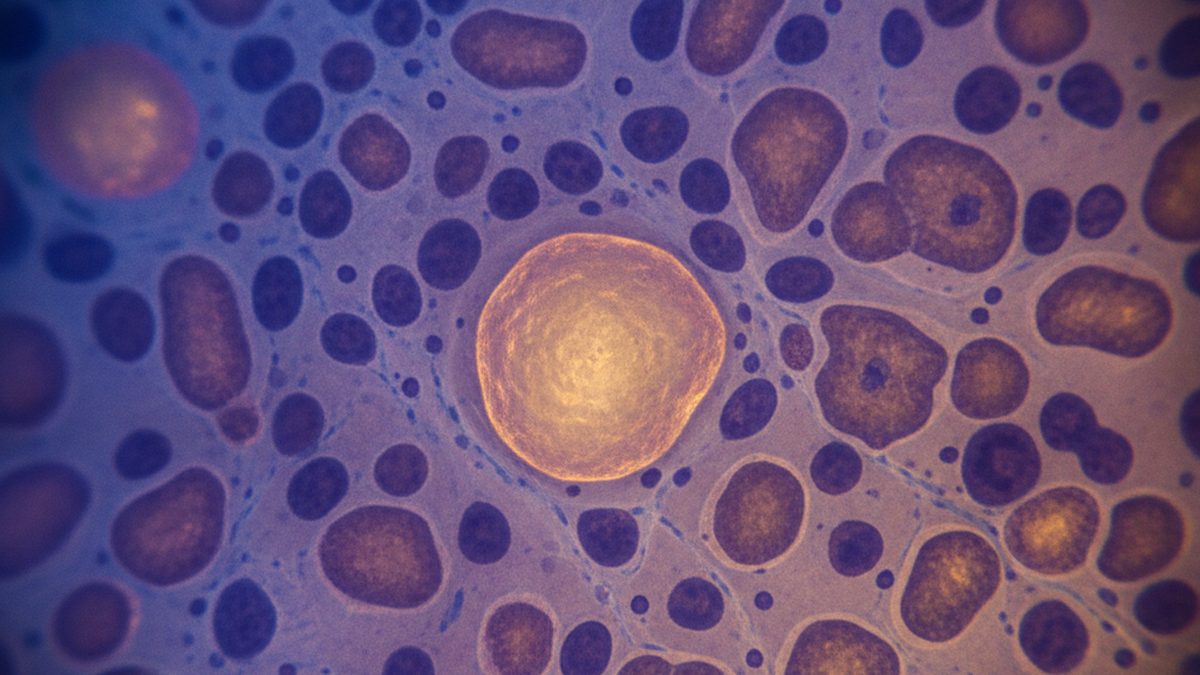
What senescent cells are — and why they matter
Every time a cell divides, it edges closer to a state called cellular senescence. Triggered by DNA damage, worn-down telomeres or metabolic stress, a senescent cell permanently stops dividing. In youth this is protective: halting a damaged cell's division is one of the body's defences against cancer, and the immune system usually clears the arrested cell soon after. The problem is time. As we age, senescent cells are produced faster and removed more slowly, so they accumulate in skin, joints, blood vessels, fat and brain.
What makes them more than inert debris is that senescent cells are metabolically loud. They secrete a cocktail of inflammatory proteins, growth factors and enzymes known as the senescence-associated secretory phenotype, or SASP. Through the SASP a single senescent cell can degrade surrounding tissue, impair stem-cell function and even convert healthy neighbours into senescent cells — which is why they earned the nickname "zombie cells." This chronic, low-grade signalling is a major driver of the smouldering inflammation behind much late-life disease, the phenomenon we cover in depth in inflammaging. Senescent-cell accumulation is now recognised as one of the twelve hallmarks of aging.
The proof of principle: clear the cells, improve the animal
The idea that these cells are not just a marker of aging but a cause of it was tested directly in mice. In a landmark 2018 study in Nature Medicine, Xu and colleagues transplanted a small number of senescent cells into young, healthy mice — and that alone was enough to cause lasting physical dysfunction, reduced walking speed and endurance, and it spread senescence to the animals' own tissues. In older mice, even fewer transplanted senescent cells shortened survival. Crucially, when the researchers then treated the animals with senolytic drugs, physical function improved and, in naturally aged mice, lifespan increased.[2] That combination — senescent cells cause dysfunction, removing them reverses it — is the foundation the entire field rests on.
Where the word "senolytic" came from
The drug class itself was named in 2015. Working from the observation that senescent cells switch on specific pro-survival pathways to resist their own death, Zhu and colleagues at the Mayo Clinic reasoned that briefly blocking those pathways should tip the cells into apoptosis. Screening for compounds that hit those targets, they identified the first two senolytics: the leukaemia drug dasatinib and the plant flavonoid quercetin. Used together in aged mice, the pair reduced senescent-cell burden, improved cardiac and vascular function within days of a single dose, and enhanced exercise capacity.[1] This is why senolytics are dosed as short intermittent "hit-and-run" pulses rather than taken daily: the goal is a one-time clearance, not continuous suppression, which also limits exposure to the drugs.
Fisetin: the natural senolytic everyone is searching for
The compound driving most of 2026's consumer interest is fisetin (chemical formula C15H10O6), a flavonoid found in small amounts in strawberries, apples and onions. Its appeal is obvious: unlike dasatinib, it is a food-derived molecule sold as a cheap supplement. In a 2018 study in EBioMedicine, Yousefzadeh and colleagues screened ten flavonoids for senolytic activity and found fisetin the most potent. Given to aged mice late in life, it reduced senescent-cell markers in multiple tissues and extended both median and maximum lifespan.[3]
Those results are genuinely striking — in mice. The honest problem is that the leap from a mouse dosed with concentrated fisetin to a human swallowing a capsule is not proven. Fisetin is poorly absorbed and rapidly metabolised in humans, so blood levels from typical supplements may fall well short of the senolytic concentrations used in animals. This is exactly the gap that rapamycin research has spent years trying to close, and it is why fisetin remains a research compound rather than a validated therapy, no matter how confidently it is marketed.
What the human trials actually show
Human data on senolytics exist, but they are early, small, and mostly in people who already have a disease rather than healthy adults chasing longevity. The first-in-human report came in 2019, when Justice and colleagues gave the dasatinib-plus-quercetin combination to fourteen patients with idiopathic pulmonary fibrosis, a fatal senescence-linked lung disease, in an open-label pilot. Over three weeks the combination was feasible and associated with improvements in several physical-function measures such as walking distance — but with no placebo group and only fourteen people, it was a signal, not proof.[4]
The most important human evidence to date arrived later that year. In a small trial in patients with diabetic kidney disease, Hickson and colleagues showed that just three days of dasatinib plus quercetin measurably reduced the number of senescent cells in human fat and skin tissue, confirmed on biopsy, along with lower levels of some SASP inflammatory factors.[5] This was the first direct evidence that senolytics do in people what they were designed to do — clear senescent cells. What it did not show is that this clearance makes anyone healthier or live longer; that question is still open. Larger, placebo-controlled trials are ongoing, including the Mayo Clinic's AFFIRM study testing pulsed fisetin against frailty and inflammation in older women.[6]
The cautionary tale: when senolytics failed
The field's most important reality check is the trial that did not work. Unity Biotechnology, one of the best-funded senolytic companies, developed UBX0101 to clear senescent cells inside arthritic knees. It was a clean hypothesis with strong preclinical support. Yet in its Phase 2 trial, a single injection of UBX0101 showed no statistically significant improvement in knee pain over placebo at twelve weeks, and the company halted the programme.[7] The failure matters for two reasons: it shows that clearing senescent cells does not automatically translate into a clinical benefit at every site in the body, and it is a direct rebuttal to the assumption that because the mouse data are dramatic, human results will follow. Some of the 2026 headlines claiming senolytic "breakthroughs" gloss over exactly this kind of negative result.
Honest caveats
Three limits deserve to be stated plainly. First, the strongest evidence remains in mice; the human trials are small, mostly uncontrolled, and conducted in patients with specific diseases rather than healthy people, so we cannot yet say senolytics slow human aging.[4][5] Second, safety in healthy long-term use is unknown. Dasatinib is a potent prescription cancer drug with cardiovascular and bleeding risks, and senescent cells are not uniformly harmful — some play useful roles in wound healing and tissue repair, so clearing them indiscriminately could have costs we have not measured.
Third, and most practically: buying fisetin or dasatinib online to self-dose is a genuinely bad idea. The doses, schedules and long-term consequences are exactly what the current trials are still trying to define, and prescription senolytics can interact dangerously with other drugs. The rational stance is neither dismissal nor hype. Senolytics are one of the most biologically compelling ideas in geroscience, the proof-of-concept in animals is robust, and the human payoff is still genuinely unproven. For now, the best-evidenced ways to limit senescent-cell burden are the unglamorous ones — the same fitness, muscle and metabolic health that consistently show up wherever longevity data are strongest.
References
Primary studies retrieved and verified via PubMed and ClinicalTrials.gov.
- Zhu Y, Tchkonia T, Pirtskhalava T, et al. The Achilles' heel of senescent cells: from transcriptome to senolytic drugs. Aging Cell. 2015;14(4):644–658. PubMed · DOI
- Xu M, Pirtskhalava T, Farr JN, et al. Senolytics improve physical function and increase lifespan in old age. Nature Medicine. 2018;24(8):1246–1256. PubMed · DOI
- Yousefzadeh MJ, Zhu Y, McGowan SJ, et al. Fisetin is a senotherapeutic that extends health and lifespan. EBioMedicine. 2018;36:18–28. PubMed · DOI
- Justice JN, Nambiar AM, Tchkonia T, et al. Senolytics in idiopathic pulmonary fibrosis: results from a first-in-human, open-label, pilot study. EBioMedicine. 2019;40:554–563. PubMed · DOI
- Hickson LJ, Langhi Prata LGP, Bobart SA, et al. Senolytics decrease senescent cells in humans: preliminary report from a clinical trial of dasatinib plus quercetin in individuals with diabetic kidney disease. EBioMedicine. 2019;47:446–456. PubMed · DOI
- Mayo Clinic. Alleviation by Fisetin of Frailty, Inflammation, and Related Measures in Older Adults (AFFIRM). ClinicalTrials.gov identifier NCT03430037. ClinicalTrials.gov
- UNITY Biotechnology. A study to assess the safety and efficacy of a single dose of UBX0101 in patients with osteoarthritis of the knee (Phase 2). ClinicalTrials.gov identifier NCT04129944. ClinicalTrials.gov
Common questions
What are senolytics and how do they work?
Senolytics are drugs or natural compounds that selectively kill senescent cells — aged cells that stop dividing but refuse to die and instead leak inflammatory SASP signals into surrounding tissue.[1] They work by briefly switching off the survival pathways senescent cells depend on, pushing them into programmed cell death while sparing healthy cells. Because the effect is a one-time clearance, they are given in short intermittent pulses rather than daily.
Is fisetin a proven senolytic in humans?
Not yet. Fisetin (C15H10O6) was the most potent of ten flavonoids screened in Mayo Clinic work and extended lifespan in mice.[3] Human trials such as the AFFIRM study in frail older women are ongoing,[6] but no completed randomized trial has shown it clears senescent cells or improves aging outcomes in people. Treat it as a promising research compound, not an established therapy.
Are senolytics safe to take?
The safety of senolytics in healthy people taking them for longevity is not established. Dasatinib is a prescription cancer drug with real side effects, and even short senolytic courses have been tested mostly in small pilot studies in people who already have a disease.[4] Self-experimenting with fisetin or dasatinib bought online carries genuine risk, including drug interactions. Any use should happen only inside a supervised trial or under a physician's care.