What urolithin A actually is
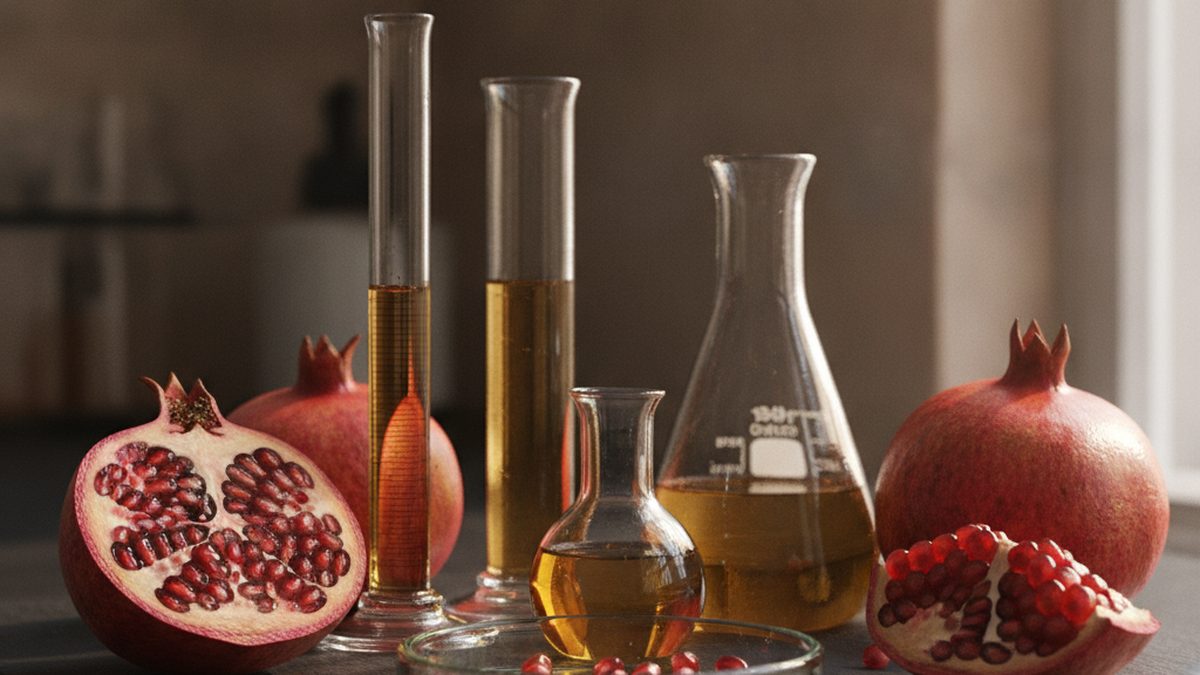
Urolithin A is one of the more counter-intuitive molecules in longevity science, because you cannot get it directly from any food. What you eat are ellagitannins and ellagic acid — large polyphenols concentrated in pomegranates, walnuts, raspberries and strawberries. Those compounds are barely absorbed on their own. Instead, specific bacteria in the large intestine break them down over one to two days into urolithins, of which urolithin A (chemical formula C13H8O4, a dihydroxy-dibenzopyranone) is the most biologically active.
This is where the first honest caveat arrives. The gut bacteria needed to make urolithin A are not universal. Population studies suggest only around 30–40% of adults are efficient "urolithin producers," a trait researchers call the urolithin metabotype. The rest convert ellagitannins poorly or not at all. That single fact explains why eating pomegranates is an unreliable way to raise urolithin A, and why the human trials that matter used a purified, directly administered form (sold under the ingredient name Mitopure) rather than trusting diet and the microbiome to do the job.[6]
The mechanism: mitophagy, not stimulation
Mitochondria are the structures that turn food and oxygen into usable cellular energy, and they take damage in the process. A healthy cell disposes of its faulty mitochondria through a quality-control process called mitophagy — a targeted form of autophagy that tags and digests worn-out mitochondria so fresh ones can replace them. Mitophagy becomes less efficient with age, and the resulting build-up of dysfunctional mitochondria is one of the recognised hallmarks of aging, closely tied to declining muscle and organ function.[6]
Urolithin A's defining action, first characterised in worms and rodents and later confirmed in human cells, is that it induces mitophagy. In pre-clinical models it improved mitochondrial function and extended lifespan in the nematode C. elegans and increased running endurance in mice. Crucially, this is not stimulation in the caffeine sense — there is no acute energy hit. The proposed benefit is slow and structural: clear the damaged mitochondria, prompt new ones to form, and let a tissue's overall mitochondrial quality drift upward over weeks. That mechanism is what the human trials set out to test.
The first-in-human safety study
The molecule crossed into serious clinical territory in 2019, when Andreux and colleagues published the first-in-human trial in Nature Metabolism. In a randomized, double-blind, placebo-controlled study, healthy but sedentary older adults received single or repeated doses of urolithin A up to 1,000 mg. The compound was well tolerated with a favourable safety profile, reached the bloodstream reliably, and — the key finding — shifted gene expression in skeletal muscle toward a signature of improved mitochondrial and cellular health, consistent with its proposed mitophagy mechanism.[1] It was proof of two things at once: that oral urolithin A is bioavailable and safe over the short term, and that it engages the biology it is supposed to engage.
Muscle and exercise: the strongest human data
The most developed line of evidence concerns muscle. In a 2022 randomized clinical trial published in JAMA Network Open, Liu and colleagues gave healthy older adults (aged 65–90) either placebo or urolithin A for four months. The supplement did not increase peak muscle power, but it produced a statistically significant improvement in muscle endurance — measured as the number of contractions until fatigue in the hand and leg muscles — and favourably changed several plasma biomarkers of mitochondrial and cellular health.[3]
A parallel 2022 trial in Cell Reports Medicine extended the picture to middle-aged adults. Over four months, Singh and colleagues found that daily urolithin A improved muscle strength (measured in the leg) and aerobic endurance, alongside reductions in circulating markers of inflammation and biomarkers linked to mitochondrial dysfunction.[2] Taken together, these two randomized trials are the backbone of the urolithin A case: consistent, placebo-controlled signals on muscle performance and mitochondrial markers in the two age groups most relevant to healthy aging. The effect sizes are real rather than dramatic, and they matter most for people whose muscle function is already declining — a theme that connects directly to why muscle and strength after 40 behave like a longevity organ.
Newer signals: the heart and the immune system
Two more recent studies pushed urolithin A beyond muscle. In early 2025, a paper in iScience combined animal work with human biomarker data and reported that four months of urolithin A in healthy older adults significantly reduced specific plasma ceramides — including species that make up a clinically validated cardiovascular risk score (CERT1). In the pre-clinical arm, the compound reduced both systolic and diastolic cardiac dysfunction in models of aging and heart failure, effects tied to restored mitophagy in heart tissue.[5] Lower ceramide risk scores are a meaningful surrogate for cardiovascular risk, though a surrogate is not the same as a reduction in heart attacks.
The freshest evidence, published in Nature Aging in late 2025, turned to immunity. In a randomized, placebo-controlled trial, Denk and colleagues gave healthy middle-aged adults 1,000 mg of urolithin A daily for four weeks and found it expanded populations of less-exhausted, naive-like CD8+ T cells and increased their capacity to burn fat for fuel — changes that run counter to the usual direction of age-related immune decline, or immunosenescence.[4] It is an early, short study on immune-cell biology rather than on infections or disease, but it widens the compound's plausible reach from muscle into the aging immune system — the same decline that feeds the chronic, low-grade inflammaging behind much late-life illness.
Dosage and what "Mitopure" is
Across the human trials, the doses cluster tightly: 500 mg to 1,000 mg of purified urolithin A per day, taken for four weeks to four months. Almost all of this research used a single manufactured, food-grade form of the molecule (the ingredient Mitopure), which sidesteps the metabotype problem by delivering urolithin A directly rather than relying on your gut bacteria to make it. There is no established optimal long-term dose, no evidence that going above 1,000 mg adds benefit, and no data yet on multi-year use. Urolithin A is regulated as a dietary ingredient, not an approved drug, which means quality and actual content can vary between products that are not the studied ingredient.
Honest caveats
Three limits deserve to be stated plainly. First, every human trial so far has measured surrogate outcomes — muscle endurance, biomarkers, immune-cell phenotypes — over weeks or months, not healthspan or survival over years.[2][3][4] There is no evidence that urolithin A extends human lifespan, and no trial has been designed or run long enough to find out.
Second, the effects that do exist are modest and specific. The muscle trials improved endurance and some strength measures, not peak power, and the changes were incremental rather than transformative. A compound that nudges mitochondrial quality is a supporting actor next to interventions with hard mortality data behind them — a high VO₂ max, preserved muscle, and consistent sleep. Urolithin A cannot substitute for the physiological reserve those build.
Third, much of the strongest research has been conducted or funded by the company that commercialised the ingredient, which is common for a proprietary compound but is a reason for measured interpretation and a need for fully independent replication. The rational stance is neither dismissal nor hype: urolithin A is one of the better-evidenced longevity supplements, its safety record over months is reassuring, and its long-term payoff in humans is still unproven. All three of those are true at once.
References
Primary studies retrieved and verified via PubMed.
- Andreux PA, Blanco-Bose W, Ryu D, et al. The mitophagy activator urolithin A is safe and induces a molecular signature of improved mitochondrial and cellular health in humans. Nature Metabolism. 2019;1(6):595–603. DOI
- Singh A, D'Amico D, Andreux PA, et al. Urolithin A improves muscle strength, exercise performance, and biomarkers of mitochondrial health in a randomized trial in middle-aged adults. Cell Reports Medicine. 2022;3(5):100633. PubMed · DOI
- Liu S, D'Amico D, Shankland E, et al. Effect of urolithin A supplementation on muscle endurance and mitochondrial health in older adults: a randomized clinical trial. JAMA Network Open. 2022;5(1):e2144279. PubMed · DOI
- Denk D, Singh A, Kasler HG, et al. Effect of the mitophagy inducer urolithin A on age-related immune decline: a randomized, placebo-controlled trial. Nature Aging. 2025. PubMed · DOI
- Liu S, Faitg J, Tissot C, et al. Urolithin A provides cardioprotection and mitochondrial quality enhancement preclinically and improves human cardiovascular health biomarkers. iScience. 2025;28(2):111814. PubMed · DOI
- D'Amico D, Andreux PA, Valdés P, Singh A, Rinsch C, Auwerx J. Impact of the natural compound urolithin A on health, disease, and aging. Trends in Molecular Medicine. 2021;27(7):687–699. DOI
Common questions
What does urolithin A do in the body?
It activates mitophagy — the cell's program for clearing out worn-out mitochondria and replacing them with new ones. By raising mitochondrial quality over time, it has produced measurable effects on muscle endurance and on cardiovascular and immune biomarkers in human trials.[1][3] It is not a stimulant; the effect is gradual, building over weeks rather than hours.
What is the best urolithin A dosage?
The randomized human trials used 500–1,000 mg per day of the purified ingredient for four weeks to four months, and the 2019 first-in-human study found doses up to 1,000 mg well tolerated.[1][2] There is no established long-term dose and no evidence that more than 1,000 mg adds benefit. Discuss any supplement with a clinician first.
Can you get enough urolithin A from pomegranates?
Not reliably. Pomegranates, walnuts and berries supply ellagitannins, but your gut bacteria have to convert them into urolithin A — and only an estimated 30–40% of people carry the microbes to do it well, a trait called the urolithin metabotype.[6] That is why trials use a purified form: two people eating the same fruit can end up with very different blood levels.