What GlyNAC actually is
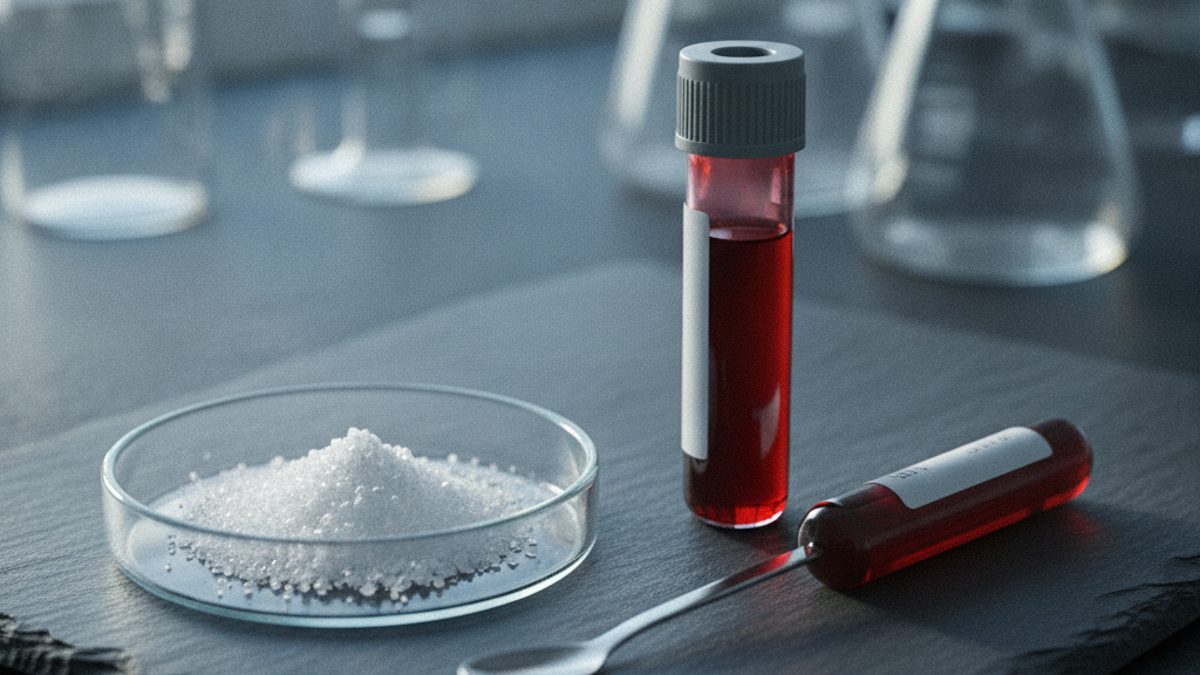
GlyNAC is one of the least glamorous entries in longevity science, because it is not a novel molecule at all. It is a fixed combination of two ordinary amino acids: glycine (chemical formula C2H5NO2, the smallest amino acid) and N-acetylcysteine, or NAC (C5H9NO3S), a stable, well-absorbed form of the amino acid cysteine. The name is just the two components stuck together: Glycine + NAC.
The reason to pair them is glutathione (C10H17N3O6S), a tripeptide built from glutamate, cysteine and glycine that serves as the principal antioxidant inside cells — the molecule that neutralises reactive oxygen species before they damage DNA, proteins and mitochondrial membranes. To synthesise glutathione a cell needs raw material, and the two rate-limiting supplies are cysteine and glycine. The central hypothesis, developed largely by Rajagopal Sekhar's group at Baylor College of Medicine, is that older adults become deficient in glutathione because they run short of both precursors, and that supplying them together — rather than either alone — is what lets the cell rebuild its antioxidant defences.[3]
The mechanism: precursors, not the antioxidant itself
An obvious question is why not simply swallow glutathione. The answer is that oral glutathione is largely broken down in digestion and raises intracellular levels poorly. Providing the building blocks lets the cell manufacture glutathione where it is actually used. NAC supplies cysteine, which is usually the scarcer of the two precursors; glycine covers the other. In cell and rodent work, correcting this deficiency restored the cell's capacity to buffer oxidative stress and, downstream, improved mitochondrial fuel oxidation — the efficiency with which mitochondria burn fat and glucose for energy.[3]
That link matters because rising oxidative stress and declining mitochondrial function are two recognised hallmarks of aging, and they feed a cascade of others: chronic inflammation, insulin resistance, endothelial dysfunction and genomic damage. The GlyNAC thesis is essentially that a single upstream deficiency — too little glutathione — helps drive several of these defects at once, so correcting it should improve them together. It is an elegant hypothesis. The relevant question is how well it survives contact with human trials.
The pilot trial and the randomized trial
The strongest supporting data come from two Baylor studies. The first, published in Clinical and Translational Medicine in 2021, was a 36-week open-label pilot in eight older adults and eight young controls. Older adults received GlyNAC for 24 weeks, then stopped for 12 weeks. During supplementation, red-blood-cell glutathione deficiency and oxidative stress were corrected, mitochondrial fuel oxidation improved, and markers of inflammation, insulin resistance, endothelial dysfunction and genomic damage all moved in a favourable direction — alongside measurable gains in strength, gait speed and cognition. Crucially, most of those benefits receded after GlyNAC was withdrawn, which is exactly the pattern you expect from a real, dose-dependent effect rather than chance.[2]
The second, published in The Journals of Gerontology: Series A in 2023, is the one that put GlyNAC on the longevity map because it was randomized and placebo-controlled. Twenty-four older adults were assigned to either GlyNAC or an isonitrogenous alanine placebo for 16 weeks, with twelve young adults studied for reference. Compared with placebo, GlyNAC corrected glutathione deficiency and oxidative stress, improved mitochondrial dysfunction, lowered inflammation and insulin resistance, improved endothelial function and blood pressure, and produced gains in muscle strength, gait speed and the six-minute walk test — while also shifting several molecular hallmarks of aging. It was safe and well tolerated over the four months.[1] For a nutritional intervention, improving that many distinct systems in one controlled trial is unusual, and it is why GlyNAC attracted serious attention.
Beyond healthy aging: the HIV signal
A related open-label trial in people living with HIV — a group that shows features of accelerated, premature aging — reported the same broad pattern: correcting glutathione with GlyNAC improved oxidative stress, mitochondrial function, inflammation, insulin resistance, genomic damage, strength and cognition, with benefits again fading after withdrawal.[5] This does not prove anything about lifespan, but it is mechanistically consistent: where glutathione deficiency is more severe, correcting it appears to do more. That consistency across two different aging-related contexts is part of what makes the biology credible even while the outcome data stay thin.
The trial that complicates the story
Here is the counterweight that honest coverage has to include. In 2022, a team from Nestlé Health Science ran the largest GlyNAC trial to date — a randomized, controlled study in 114 healthy older adults (mean age 65) testing three daily doses (2.4, 4.8 and 7.2 grams, glycine and NAC in a 1:1 ratio) over two weeks. Despite confirming that these older adults did have elevated oxidative-stress markers at baseline, GlyNAC did not raise the ratio of reduced to oxidised glutathione or total glutathione across the cohort — the study's primary endpoint. Only in a post-hoc subgroup with both high oxidative stress and low baseline glutathione, taking the medium or high dose, did glutathione rise significantly.[4]
Two caveats blunt this result — the Nestlé trial lasted only two weeks versus 16–24 weeks at Baylor, and glutathione demand may simply be lower in a generally healthy cohort — but it cannot be waved away. A larger, independent, industry-run trial failing to reproduce the headline biomarker is precisely the kind of signal that separates a robust finding from a fragile one. The most defensible reading is that GlyNAC's glutathione effect is real but conditional: it shows up most clearly in people who are genuinely deficient and stressed, over longer durations, and much less in everyone else.
Dosage and safety
The Baylor trials dosed glycine and NAC by body weight — on the order of 100 mg per kilogram per day of each — taken for 16 to 24 weeks, which for an average adult lands in the multi-gram-per-day range. The Nestlé trial used fixed doses of 2.4 to 7.2 grams total daily. GlyNAC was well tolerated in all of these studies, consistent with the long clinical safety record of NAC, which has been used for decades at high doses in medicine. There is no established optimal long-term dose, no multi-year human safety data specific to this combination, and NAC can interact with certain medications, so high-dose use is not something to improvise without medical supervision.
Honest caveats
Three limits deserve to be stated plainly. First, no GlyNAC trial has measured lifespan or hard clinical outcomes — every human study to date has tracked surrogate markers (glutathione, oxidative stress, mitochondrial and inflammatory markers, strength and gait) over weeks to months.[1][2] "Reversing hallmarks of aging" describes changes in biomarkers, not proof of a longer or healthier life.
Second, the flagship positive trials are small and concentrated in one research group. Eight and twenty-four older adults are pilot-scale numbers, and the most striking claims rest heavily on Baylor's work; the one large independent trial missed its primary endpoint.[4] That is not evidence GlyNAC does nothing — it is a reason to treat the broad "improves everything" narrative with caution until larger, independent, longer trials replicate it.
Third, GlyNAC is a supporting intervention, not a foundation. The systems it touches — mitochondrial function, chronic inflammation, muscle — respond far more powerfully to inputs with hard outcome data behind them. The chronic low-grade inflammation of aging is driven by many factors beyond glutathione; preserving muscle after 40 depends overwhelmingly on resistance training and protein intake; and mitochondrial quality is also the target of better-studied compounds like urolithin A. The rational stance on GlyNAC is neither dismissal nor hype: it is a cheap, safe, mechanistically sensible combination with genuinely intriguing early data and no proof of a longevity payoff yet. All of that is true at once.
References
Primary studies retrieved and verified via PubMed.
- Kumar P, Liu C, Suliburk J, et al. Supplementing Glycine and N-Acetylcysteine (GlyNAC) in Older Adults Improves Glutathione Deficiency, Oxidative Stress, Mitochondrial Dysfunction, Inflammation, Physical Function, and Aging Hallmarks: A Randomized Clinical Trial. J Gerontol A Biol Sci Med Sci. 2023;78(1):75–89. PubMed · DOI
- Kumar P, Liu C, Hsu JW, et al. Glycine and N-acetylcysteine (GlyNAC) supplementation in older adults improves glutathione deficiency, oxidative stress, mitochondrial dysfunction, inflammation, insulin resistance, endothelial dysfunction, genotoxicity, muscle strength, and cognition: Results of a pilot clinical trial. Clin Transl Med. 2021;11(3):e372. PubMed · DOI
- Sekhar RV. GlyNAC Supplementation Improves Glutathione Deficiency, Oxidative Stress, Mitochondrial Dysfunction, Inflammation, Aging Hallmarks, Metabolic Defects, Muscle Strength, Cognitive Decline, and Body Composition: Implications for Healthy Aging. J Nutr. 2021;151(12):3606–3616. PubMed · DOI
- Lizzo G, Migliavacca E, Lamers D, et al. A Randomized Controlled Clinical Trial in Healthy Older Adults to Determine Efficacy of Glycine and N-Acetylcysteine Supplementation on Glutathione Redox Status and Oxidative Damage. Front Aging. 2022;3:852569. PubMed · DOI
- Kumar P, Liu C, Suliburk JW, et al. Supplementing Glycine and N-acetylcysteine (GlyNAC) in Aging HIV Patients Improves Oxidative Stress, Mitochondrial Dysfunction, Inflammation, Endothelial Dysfunction, Insulin Resistance, Genotoxicity, Strength, and Cognition. Biomedicines. 2020;8(10):390. PubMed · DOI
- Kumar P, Osahon OW, Sekhar RV. GlyNAC (Glycine and N-Acetylcysteine) Supplementation in Old Mice Improves Brain Glutathione Deficiency, Oxidative Stress, Mitochondrial Dysfunction, Inflammation and Neurotrophic Factors to Reverse Age-Associated Cognitive Decline. Antioxidants (Basel). 2023;12(5):1042. PubMed · DOI
Common questions
What is GlyNAC and what does it do?
GlyNAC combines glycine (C2H5NO2) and N-acetylcysteine (C5H9NO3S), the two precursors cells use to build glutathione (C10H17N3O6S), their main internal antioxidant. Supplying both together aims to correct the glutathione deficiency common in older adults. In Baylor trials this was accompanied by lower oxidative stress and better mitochondrial function,[1] though the largest independent trial did not replicate the glutathione rise in a general older cohort.[4]
What is the GlyNAC dosage used in studies?
The Baylor trials dosed glycine and NAC by body weight — roughly 100 mg per kilogram per day of each — for 16 to 24 weeks.[1][2] The larger Nestlé trial used fixed daily doses of 2.4, 4.8 or 7.2 grams total.[4] There is no established optimal long-term dose, and high-dose NAC should not be combined with medication without medical supervision.
Does GlyNAC actually reverse aging?
No — that overstates the evidence. GlyNAC improved surrogate markers (glutathione, oxidative stress, mitochondrial fuel oxidation, inflammation, strength, gait speed) in small trials over weeks to months.[1][2] It has not been shown to extend human lifespan, the flagship trials were small and largely from one group, and a larger independent trial missed its primary glutathione endpoint.[4]