What glycation actually is
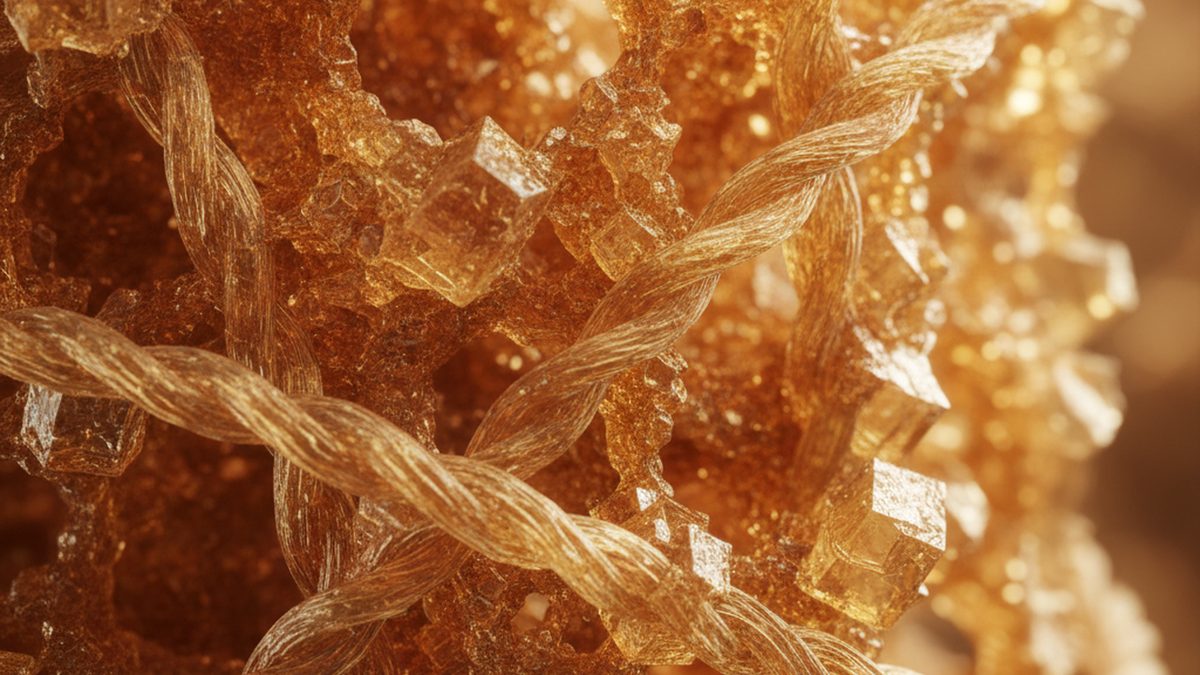
Most of the chemistry in your cells is run by enzymes that act quickly, specifically and reversibly. Glycation is the opposite. It is a slow, spontaneous reaction — no enzyme required — in which a sugar molecule latches onto a protein or lipid. It begins when the aldehyde group of glucose (chemical formula C6H12O6) reacts with an amino group on a protein to form a loose early adduct, the Schiff base, which settles into a more stable Amadori product. Over weeks to years, that rearranges through a cascade collectively called the Maillard reaction into a diverse family of permanent structures: the advanced glycation end products.
This is the same reaction that browns a steak or toasts bread. In food it takes minutes at high heat; in the body it runs at 37 °C over a lifetime. Some of the most damaging AGEs do not even come from glucose directly but from far more reactive by-products of metabolism such as methylglyoxal (C3H4O2), a dicarbonyl that glycates proteins hundreds of times faster than glucose does. The best-characterised stable AGE is Nε-carboxymethyl-lysine, or CML (C8H16N2O4), which accumulates on long-lived proteins and is widely used as a marker of total AGE burden. Another, glucosepane, forms rigid cross-links between adjacent collagen strands and is the dominant cross-link in aged human tissue.
The reason glycation matters for aging is a matter of timing. Proteins that turn over quickly are replaced before much damage sticks. But the body's structural scaffolding — the collagen and elastin in skin, blood-vessel walls, tendons and the lens of the eye — can last years or decades. Those long-lived proteins have time to accumulate AGEs, and once cross-linked they are hard to break down. Glycation is therefore not a disease in itself but a form of slow, cumulative molecular damage, which is why it is increasingly discussed alongside the recognised hallmarks of aging.
Why AGEs drive aging: the AGE–RAGE axis
AGEs harm tissue through two distinct routes. The first is mechanical. When AGEs such as glucosepane cross-link collagen fibres to one another, they turn a supple, elastic matrix into a stiffer, more brittle one. In arteries this contributes to the loss of compliance that raises pulse pressure with age; in skin it is part of the loss of elasticity; in the kidney and lens it stiffens tissue that depends on flexibility to work.
The second route is inflammatory signalling. AGEs are recognised by a cell-surface receptor called RAGE (the receptor for advanced glycation end products). According to PubMed, a review by Reynaert and colleagues in the International Journal of Biochemistry & Cell Biology details how AGE–RAGE engagement amplifies inflammatory responses and is implicated across a cluster of age-related, non-communicable diseases — including cardiovascular disease, type 2 diabetes, chronic obstructive pulmonary disease and osteoporosis — all of which share an accelerated-aging phenotype hallmarked by chronic inflammation and oxidative stress.[1] That inflammatory loop connects glycation directly to the slow, smouldering process behind much late-life disease, the same fire discussed in our piece on inflammaging.
Crucially, the two routes reinforce each other. Diabetes, where blood glucose runs high for years, accelerates AGE formation and is the clearest natural experiment in fast-forward glycation — a large part of why poorly controlled diabetes damages kidneys, nerves, retinas and arteries. This is also the mechanistic bridge to metabolic health more broadly: anything that lowers chronic blood-sugar exposure slows the internal production of AGEs, which is one reason interventions that improve glucose control, from diet to the GLP-1 drugs, are of interest well beyond weight.
The evidence that AGEs track how we age
AGEs are not just a laboratory curiosity; they can be measured in living people and they predict outcomes. Because many AGEs fluoresce, tissue accumulation can be estimated non-invasively by shining light on the skin — a technique called skin autofluorescence (SAF). The reading reflects AGEs built up in dermal collagen and behaves as a kind of slow biological odometer.
According to PubMed, a five-year prospective study by Viramontes-Hörner and colleagues in Kidney International Reports followed 120 people on haemodialysis — a group in which AGEs accumulate rapidly — and found that both a higher baseline skin-autofluorescence reading and a rising SAF trend over time were independent predictors of all-cause mortality, with an increasing trend carrying a hazard ratio of 2.37 (95% CI 1.43–3.93).[2] The signal is strongest in kidney disease, where glycation is extreme, and should not be over-generalised to healthy adults. But it establishes an important point: the accumulated products of glycation are not inert. They correlate with the trajectory of survival, which is exactly what you would expect if glycation were a genuine driver of tissue aging rather than a bystander.
The 2026 breakthrough: an enzyme that reverses CML
For most of the field's history, the working assumption was that AGE cross-links, once formed, are effectively permanent — you could hope to slow their formation but not remove them. That assumption is what makes a paper published on 14 July 2026 notable. Researchers at Revel Pharmaceuticals, working with Calico Life Sciences and the University of Colorado Anschutz Medical Campus, reported in Nature Communications an engineered enzyme, named CMLase, that enzymatically reverses carboxymethyl-lysine damage on proteins.[3]
Using directed evolution across more than 500 million enzyme variants, starting from a bacterial glycine-oxidase scaffold, the team produced an enzyme that oxidises the CML modification and restores the original, undamaged lysine residue on the protein. Applied to excised human tissue, it reduced CML by more than 70% in arterial samples, more than 55% in skin, and between 45% and 78% in lens proteins. In their most striking result, a 75-year-old donor's arterial tissue was brought down to a CML burden comparable to that of a roughly 30-year-old.
This is a real conceptual shift — from delaying damage to actively repairing it, a repair-not-slow philosophy it shares with the senolytics that aim to clear damaged cells rather than prevent them. But the caveats are large and the authors state them plainly. All of this was done ex vivo, on tissue removed from the body, not in a living organism. CML is only one AGE among many, and notably it is not itself a cross-link, so removing it does not by itself un-stiffen cross-linked collagen. Whether such an enzyme can be delivered into human tissue, whether the immune system tolerates it, and whether stripping CML actually restores function all remain open questions. It is a proof of principle of the highest interest — and years of work away from anything a person could take.
The cautionary tale: crosslink breakers
The 2026 enthusiasm should be read against an earlier chapter that ended in disappointment. In the 2000s, a compound called alagebrium (ALT-711) was developed as an "AGE crosslink breaker," and early human work was encouraging. According to PubMed, a small phase-II trial by Zieman and colleagues in the Journal of Hypertension gave alagebrium to older adults with isolated systolic hypertension and found improved endothelial function and a 37% reduction in a measure of arterial stiffness.[4] Yet despite promising surrogate-marker results like these, alagebrium never translated into an approved therapy; its development was ultimately abandoned, and later analysis questioned whether it broke established cross-links at all rather than acting through other mechanisms. The lesson is not that the target is wrong — it is that improving a biomarker in a short trial is a long way from a durable clinical benefit, and glycation has broken more than one confident hypothesis.
What you can actually do about glycation
No supplement is proven to remove AGEs from human tissue, and the honest, evidence-based levers are unglamorous. Two stand out.
Control blood sugar. Because internal AGE formation scales with how much glucose your proteins are bathed in over time, the single most powerful lever is long-term glycaemic control. The habits that flatten glucose exposure — regular physical activity, preserving muscle, limiting refined carbohydrate and ultra-processed food, and maintaining a healthy weight — also slow endogenous glycation. This is metabolic-health advice arriving by a different door.
Change how you cook. A meaningful share of the AGEs in your body is eaten, and diet is modifiable. Dry, high-heat cooking — grilling, roasting, frying, broiling — generates far more AGEs than moist, gentler methods such as steaming, boiling, poaching and stewing; animal fats and highly processed foods tend to be AGE-rich, while vegetables, fruit, whole grains and legumes are low. According to PubMed, a randomized controlled trial by Kahleova and colleagues in Maturitas showed that shifting postmenopausal women to a low-fat, plant-based diet cut estimated dietary AGE intake by 73% — roughly 5,500 kilounits per day — demonstrating that the dietary AGE load is a large, genuinely controllable variable.[5] Whether lowering dietary AGEs changes hard clinical outcomes is less settled than the intake reduction itself, which is the honest place to leave it.
Honest caveats
Three limits deserve stating plainly. First, much of the strongest human data linking AGEs to outcomes comes from populations where glycation is extreme — people with diabetes or on dialysis — and cannot be assumed to apply with the same force to healthy adults. Second, dietary AGEs are not uniformly harmful across every endpoint: according to PubMed, a 2024 systematic review and meta-analysis of prospective cohorts by Sharifi-Zahabi and colleagues in Food Science & Nutrition, pooling over 1.2 million participants, found no significant association between dietary AGE intake and overall cancer risk.[6] Glycation is one thread in aging, not the whole cloth. Third, and most important for the news cycle: the 2026 enzyme result, genuinely exciting as it is, was achieved on tissue in a dish. The graveyard of anti-glycation therapies that looked good on surrogate markers and then failed — alagebrium chief among them — is a reminder to hold the excitement and the skepticism at once. Glycation is a real, measurable contributor to how tissue ages; reversing it in a living human is still an unsolved problem.
References
Primary studies retrieved and verified via PubMed and the publishing journals.
- Reynaert NL, Gopal P, Rutten EPA, Wouters EFM, Schalkwijk CG. Advanced glycation end products and their receptor in age-related, non-communicable chronic inflammatory diseases. Int J Biochem Cell Biol. 2016;81(Pt B):403–418. PubMed · DOI
- Viramontes-Hörner D, Selby NM, Taal MW. Prospective study of change in skin autofluorescence over time and mortality in people receiving hemodialysis. Kidney Int Rep. 2024;9(7):2110–2116. PubMed · DOI
- Revel Pharmaceuticals, Calico Life Sciences, University of Colorado Anschutz. Reversal of protein chemical aging by enzymatic deglycation. Nature Communications. 2026. DOI · Nature Communications
- Zieman SJ, Melenovsky V, Clattenburg L, et al. Advanced glycation endproduct crosslink breaker (alagebrium) improves endothelial function in patients with isolated systolic hypertension. J Hypertens. 2007;25(3):577–583. PubMed · DOI
- Kahleova H, Znayenko-Miller T, Uribarri J, et al. Dietary advanced glycation end-products and postmenopausal hot flashes: a post-hoc analysis of a 12-week randomized clinical trial. Maturitas. 2023;172:32–38. PubMed · DOI
- Sharifi-Zahabi E, Soltani S, Hajizadeh-Sharafabad F, Abdollahzad H. Dietary advanced glycation end-products are not associated with the risk of cancer incidence: a systematic review and meta-analysis of prospective cohort studies. Food Sci Nutr. 2024;12(10):7788–7797. PubMed · DOI
Common questions
What are advanced glycation end products (AGEs)?
AGEs are proteins and lipids permanently modified by sugar. When glucose (C6H12O6) and reactive by-products like methylglyoxal (C3H4O2) attach to long-lived proteins such as collagen, they form stable adducts and cross-links — the same browning chemistry as toast, running slowly in the body over decades.[1] The best-studied AGE is carboxymethyl-lysine (CML). AGEs accumulate with age, stiffen tissue and drive inflammation through the RAGE receptor.
How can I reduce AGEs in my body?
The two best-evidenced levers are blood-sugar control and cooking method. High blood glucose speeds internal AGE formation, so the habits that improve glucose control also lower AGE production. Separately, dry high-heat cooking (grilling, frying, roasting) creates far more dietary AGEs than moist, gentler methods (steaming, boiling, poaching, stewing); a plant-rich diet cooked gently cut estimated AGE intake by 73% in one randomized trial.[5] No supplement is proven to strip AGEs from human tissue.
Can advanced glycation end products be reversed?
Not yet in living people. In July 2026, researchers reported an engineered enzyme, CMLase, that removed more than 70% of carboxymethyl-lysine from human arterial tissue in the lab, restoring a 75-year-old sample toward levels seen at around 30.[3] But this was done ex vivo on excised tissue, and delivery, safety and functional recovery remain unanswered. Earlier crosslink-breaker drugs failed in humans,[4] so the honest answer is: promising in principle, unproven in people.